 |
| Porters carry huge load across mountains of Nepal |
Jul 7, 2012
Nepali Porters
Do you think your job is hard ? You probably don't know about the Nepali porters. Their job is one of the hardest ones known to me.
Jun 23, 2012
Mule Train
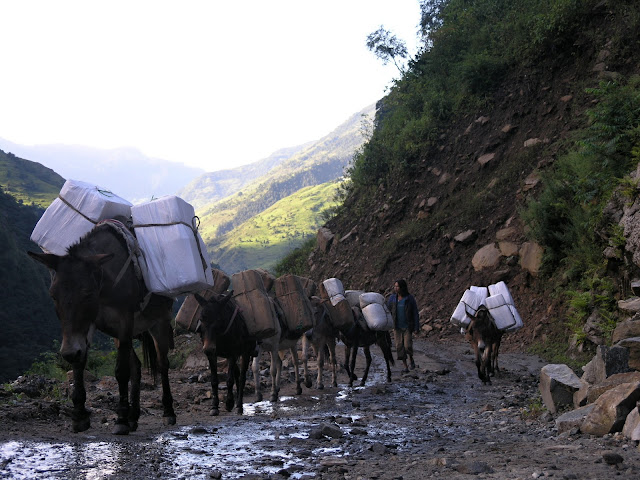 |
| Mule Train, photo credit: Subbotsky |
Jun 1, 2012
Stone in Nepali Masonry
 |
| Houses are made of brick sized stone slabs, mud-gravel mixture is used as mortar |
Stone is predominant material in Nepali masonry. Specially in the Himalayan parts. Rough slabs of about uniform thickness is the most common form. Mud-gravel mixture is usually used as mortar. The slabs in use having varying length/breadth gives rise to an strong organic texture, unlike the regular pattern of brick walls.
Stone slabs are also laid on flat ground to make pavements, much like cobblestones are used in European architecture. Slabs are laid on sloppy hillsides to make stair ways. Large to medium stone slabs are usually used. These stairs can go all the way starting from deep river valleys to the villages perched on mountain tops.
May 26, 2012
Didi
Ladies of Nepal are your "Didi" (elder sister). That's the ubiquitous polite way of addressing a Nepali lady. You'll see them running grocery stores, tea stalls, restaurants, working in fields, carrying big loads across mountainous Nepali landscape and may be managing the hotel you're staying at.
 |
| Ongma Didi, busy maintaining business correspondence on a snowy morning in Manang. Ongma manages a hotel in Manang with her husband, Tashi. |
May 20, 2012
Picking Up Nepali Language
 Picking up a language is fun. It's like putting together a jigsaw puzzle, except that the pieces are words, phrases and grammatical structure of the language you're trying to learn. If written form of the language has a different script, that adds a new layer of challenge and fun.
Subscribe to:
Posts (Atom)