Showing posts with label Nepal. Show all posts

Dec 20, 2012

Rani Pokhari

Rani Pokhari or the Queen's Pond

Rani Pokhari or the Queen's Pond was not really on my list of places to see in Kathmandu, but I ended up passing by more than once. It's located near the center of the city and one of those hard to miss points. It's good sight to see after all. A temple to Shiva in the middle of an artificial lake accessible through a long foot bridge. But the pokhair itself is not open to public most of the days. Only on the day of Bhaitika, which is part of Tihar celebration, the gates are opened to public.

Parvati Restaurant in Pokhara

The Parvati restaurant in Pokhara has a decent dal-bhat deal besides kalo-chia, rara and of course, momo. Away from the busy lake side roads, this quiet little place is a good place to sit and relax.

Dec 16, 2012

The Red Cow in Manang

The Red Cow milk cans serves as prayer wheels in Manang

Growing up in the 80's and 90's in Bangladesh, The Red Cow powdered milk was something very familiar to me. It was also one of those things I never expected to find in another time or place. Manang proved me wrong.

Dec 15, 2012

Homemade Nepali Beer

Almost every part of Nepal have its own version of homemade beer which is frequently prepared and consumed at home. Often accompanied by small snacks. The beverage is different from what is known as beer in the western world. The organic residues have a strong presence in the form of icky taste, smell or both. Sometimes, its not that bad - its an acquired taste and getting used to with takes a while. Such was the case with Chhang in mountains. Its a great challenge in most other cases though.

Corn beer of Sindhuli


The fluid substance seen in the accompanying photo is homemade beer of Sindhuli. The yellow color (as can be seen in the photo) is due to corn from which this is made from. Citric vomit like taste and smells (which cannot be seen in the photo) is due to the fermentation process. The snacks in the small dish next to are pieces of goat meat. Neither the snack nor the drink agree much with me. But I tried my best not to offend my host. Being a world citizen is not always easy.

Dec 13, 2012

Phewa lake

View from east shore of Phewa lake before sunset
One of Pokhara's many attractions is the beautiful Phewa lake. If the sky is clear, reflection of the Annapurna range on the lake offers a spectacular view from the south shore. Many postcards and souvenirs have this picture too. Alternatively, one can watch sunset from the west shore.

You can hire a boat to get yourself to the small island in the middle of the lake. There is a nice little shrine there. Or you can actually go all the way across the lake. There is a large Buddhist temple on top of a hill on the other side. The place where they tell you to dock your boat, there is a little restaurant. The lunch served over there is very good.

View of Phewa lake and parts of Pokhara town

Machapuchare

Machhapuchare peak

My most favorite mountain in the world is Machapuchare. I first saw the it from Sarangkot. It was a cloudy evening in late August 2011. When I reached the viewing point, a thick layer of cloud was blocking my view of the peak. After a few minutes an opening formed as the clouds moved away and I could see the Machapuchare peak in it's full glory. Near the peak its too steep - almost vertical - for ice to cling on. The bare rock face was glowing in golden light of the setting sun. There was something amazingly beautiful and captivating about that bare rock face.

I fell in love and realized that I would like to climb mountains someday. Not like some arrogant mountaineers I had met before, who climb mountains to conquer them. My inspiration for climbing a mountain would be to appreciate it.

A little research on the internet afterwards reveals some interesting facts about Machhapuchare. It's almost 7000m high and lies in the Annapurna mountain range. The meaning of the Nepali name is 'Fish tail'. Named so because of its twin peaks. The mountain is revered as sacred by local people. Machapuchare has never been climbed to the summit. Out of respect for local customs, mountaineers have decided not to set foot on its peak. I learned most of these from researching on the internet after coming back home awe stricken by the sheer magnificence of Machapuchare.


Dec 12, 2012

Su Cha

The Tibetan butter tea, known as 'Su Cha' (or is it 'Su Ja' ?) in Manang is an excellent beverage for the Himalayan conditions. In absence of central heating or other such provisions to fight the cold, reliance focuses on calorie rich diet. Su Cha serves this purpose well.

Su Cha served with a couple of Tibetan breads and a plate of spicy potatoes makes a good breakfast


The preparation is very simple. Add a tablespoon of tea leaves and about 200gm of butter in 1L of hot water. Add salt according to your taste. Stir to melt all the butter, then enjoy :)

Dec 9, 2012

Yak Meat

Click on the picture to see album, WARNING: BLOOD


Although Vajrayana buddhists by religion, Manangis don't consider killing yak for meat as a taboo. Probably for practical reasons, they have resorted to tweak this part of the religious laws.

One fine morning, Tashi invited me to watch the ritualistic slaughtering and butchering of yaks. The event took place in a field on the outskirts of the village, by a little stream.

Four cows and a bull yak were slaughtered. Instead of slitting the throat open, a long narrow knife is driven right into the animals heart. This ensures quick death without spilling much blood. Every part of the animal is consumed or used in one way or another, including the blood.

Use of axe and hammer in butchering is another speciality of their culture. For an animal as thick skinned and heavy boned as the yak is, this is no surprise.

Only men are allowed to go on the butchering field. Perhaps a tradition being carried on since the hunter-gatherer period.

Skin Protection in the Himalayas


Cracked skin on my knuckles

Himalayan air is usually very dry except for the monsoon season. Skin cracks in all kind of strange places of our body. Skin on my knuckles cracked. Another guy had the palm of his hands cracked.

Locals rub fat from yak and other domestic animals on their skin to prevent cracking.

Sep 1, 2012

Yak Artifacts

Yak plays an important role in Tibetan society. Food, garments, fuel come from the yak. Over the course of evolution, the yak has also found way into their myths and folklore. Here is a collection of artifacts derived from or related to yak, as seen in and on my way to Manang, Nepal.

Yak's head is hung in the front of houses, near the entrance sometimes. Probably considered a good luck charm. The head is preserved by hollowing the skull and then drying in sun.


Yak skull used to decorate the interior of Hotel Mountain Lake. Not sure if it's for good luck or just decorative purpose.


Yak rug in Hotel Mountain Lake. Manangi equivalent of grizzly bear rug, I guess.


Dried yak meat, eaten raw.


Ceremonial yak mask, seen in Manang Heritage Museum.


Stuffed yak head, in Manang Heritage Museum


Aug 14, 2012

Yak


My first "English Alphabet & Words Book" of childhood said, "Y is for Yak". The accompanying picture looked like an odd shaped cow with long hair all over its body. I was curious whether this animal makes smooth moo sound like cow, or is it hoarse like the water buffalo ? I had to wait for the answer till my first night in Gunsang. It was early October 2012.

Aug 10, 2012

Han ye ba ?

Where are you going ?
The mountain environment influences people and their culture in amazing ways. It encourages separation of what matters more in life than what does not. Totally disregarding the latter in some instances. This influence is manifested in several ways in the culture of Manangi people, an ethnic group of Tibetan origin living in Manang district of Nepal.

If you meet a Manangi traveler on your way, the usual greeting in Manangi language is "Han ye ba ?". Where are you going ? Where you are going is more important than where you come from.

The usual response would be (if you are going to Manang) "Manang ye ba".

And after a little chat, when its time for you to go your separate ways, say "Yo jo" to each other.

Aug 8, 2012

Rara-Para-Ara


A Nepali man enjoys Ara, around mid-day
Heard this rhyme from Tashi R. Ghale, who, in his good sense of humor calls this a summary of Nepali lifestyle in the mountains.

Bihano khaunchha Rara
Dinso khelchha Para
Beluka khaunchha Ara

Aug 3, 2012

Tibbetan bread

As the name suggests, Tibetan bread is a food of the Tibetan diaspora of Nepal. A minor variation named Gurung bread can be found in some areas, e.g.: Sarangkot. Its basically a flattened dough with three parallel slits cut in the middle deep fried in oil. The Gurung bread has two slits and a few herbs infused in the dough. The bread is usually eaten for breakfast with Su Ja, the butter tea. People eat food with high fat content to fight Himalayan cold, the Tibetan bread is no exception.

Jul 28, 2012

Chapati

A nicely blown up chapati makes chef Sanjay happy

Almost every restaurant on the around Annapurna circuit serves Chapati in breakfast. Chapatis are also known as 'Roti' or 'Ruti' in some parts of South Asia. I used to make a sandwich with a fried egg tucked between two chapatis. It packs good amount of energy and fibers; good trekkers' breakfast.

Jul 17, 2012

Momo

The iconic Nepali snack momo has Tibetan origin. From the tibetan diaspora of the himalayan parts, the delicious dumpling spread to all parts of the country. A good example of culture diffusion.
momos waiting to be smoked or fried

Jul 7, 2012

Nepali Porters

Do you think your job is hard ? You probably don't know about the Nepali porters. Their job is one of the hardest ones known to me.

Porters carry huge load across mountains of Nepal

Jun 23, 2012

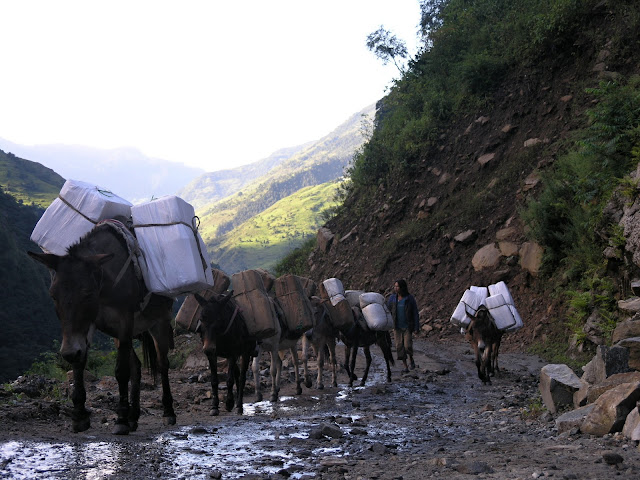
Mule Train

Mule Train, photo credit: Subbotsky
The Nepali alternative to rail cars in the Himalayas are mule trains. Villages deep in to (or high above) the Nepali Himalayas are inaccessible by motorized vehicles, let alone railway. Helicopters and small planes have emerged as a new option in recent decades. Mostly to be used in search and rescue operations. Trekking and riding stays predominant modes of traveling for personnel, while mules serve as the most common and effective options of cargo.

Jun 1, 2012

Stone in Nepali Masonry

Houses are made of brick sized stone slabs, mud-gravel mixture is used as mortar

Stone is predominant material in Nepali masonry. Specially in the Himalayan parts. Rough slabs of about uniform thickness is the most common form. Mud-gravel mixture is usually used as mortar. The slabs in use having varying length/breadth gives rise to an strong organic texture, unlike the regular pattern of brick walls.

Stone slabs are also laid on flat ground to make pavements, much like cobblestones are used in European architecture. Slabs are laid on sloppy hillsides to make stair ways. Large to medium stone slabs are usually used. These stairs can go all the way starting from deep river valleys to the villages perched on mountain tops.

May 26, 2012

Didi

Ladies of Nepal are your "Didi" (elder sister). That's the ubiquitous polite way of addressing a Nepali lady. You'll see them running grocery stores, tea stalls, restaurants, working in fields, carrying big loads across mountainous Nepali landscape and may be managing the hotel you're staying at.
Ongma Didi, busy maintaining business correspondence on a snowy morning in Manang. Ongma manages a hotel in Manang with her husband, Tashi.